
Ever been up a game and still lost the match because your legs just… gave out? Yeah. We’ve all been there. You’re moving fine for the first fifteen minutes, and then somewhere around game three your opponent starts getting to balls you swear you’d have reached last week.

It’s not that they suddenly got better. It’s that you got tired first.
Here’s the thing though — stamina isn’t some genetic lottery ticket. It’s trainable. Boringly, unglamorously trainable. Let’s get into how.
Running laps isn’t going to cut it
Most juniors, when they hear “get fitter for squash,” think: go for a run. Makes sense on paper. Except squash doesn’t really look like running.
A jog is smooth and steady. Squash is you exploding to the front corner, stopping dead, lunging for a drop shot, then scrambling back to the T before doing it all again ten seconds later.
That’s a completely different kind of fitness, and the science backs it up. Studies on elite players show that during a typical rally, the ball’s actually in play for about 10 seconds or less, and players are moving for maybe half to three-quarters of the total time on court — constant stopping and starting, not a steady cruise. Some coaches will even tell you that too much long, slow cardio can work against young players, because it trains the wrong system entirely. What actually matters on court is how fast you bounce back between sprints, not how long you can jog at an easy pace.
So what should you actually do? Intervals.
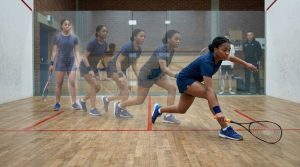
Short, hard bursts followed by a bit of recovery — that’s the closest thing squash has to a magic bullet for fitness. It matches what actually happens in a rally: sprint, recover, sprint again.
A few things worth trying:
- Court sprints. Nothing fancy — just run the length of the court as hard as you can, rest briefly, go again. Old-school, sure, but it works because it’s simple.
- Ghosting. Move around the court like you’re playing shots, minus the ball. It’s great for footwork endurance and doubles as free technique practice, which is a nice bonus.
- Bike sprints. If your knees or ankles need a break from all that floor pounding, try something like 30 seconds hard on a stationary bike followed by 15 seconds easy: same energy system, way less impact.
- T-line runs. Sprint from the T to the front, tap the tin, backpedal to the T, repeat. This one’s brutal, but it mimics the exact stop-start pattern you’ll be doing in a real match.
If you’re not sure where to start, try something like ten short sprints, rest a couple minutes, repeat for a few sets. Add more as you get fitter. You don’t need to overthink the exact numbers — just get the stop-start rhythm right and build from there.
Don’t ignore strength training
Here’s something people miss: stamina isn’t purely about lungs and legs burning. It’s also about how efficiently you move. If your legs, core, and upper body are strong, you waste less energy holding your shape through lunges and twists — which means more gas left in the tank late in a match.
Strong legs specifically help delay that heavy, sluggish feeling from repeated lunging, and there’s decent research linking better repeated-sprint ability to a stronger aerobic base — basically, the fitter your engine, the faster you recover between sprints mid-rally.
There’s a mental payoff too, honestly. When you trust your fitness, you push harder in tight moments instead of backing off because you’re scared of blowing up. Confidence in your legs changes how you play the big points.
Take it slow — you’re still growing

Junior training isn’t just adult training scaled down. A few things worth keeping in mind:
- Start light on intervals and build up gradually over weeks — not all at once.
- Nail your movement mechanics, especially turning and lunging, before you crank up the intensity. Your knees and ankles will thank you later.
- Two or three focused sessions a week is genuinely enough. You don’t need to grind every single day to see progress.
- Warm up properly. Always. It’s not optional just because you’re young and feel invincible.
A weekly plan that’s actually realistic
Nothing complicated needed here. Something like this works well:
- One on-court interval session — ghosting or T-line runs
- One off-court interval session — bike sprints or court sprints
- One strength session — bodyweight or light resistance, legs and core focus
- Proper rest — this is where the actual adaptation happens, not during the workout itself
Layer your regular coaching and match play around that, and you’ve got a pretty solid week without overcomplicating things.
Bottom line
Forget grinding out slow miles. Squash stamina comes from training your body to sprint, recover, and sprint again — over and over, just like a real match. Mix in some strength work, be patient with the progression, and stay consistent. Stick with it for a couple of months, and you’ll be the one still moving well in game five while the other player starts fading.
References
- Girard, O., et al. “Game Analysis and Energy Requirements of Elite Squash”, PubMed
- James, C.A., Dhawan, A., Jones, T., Girard, O. (2021). “Quantifying Training Demands of a 2-Week In-Season Squash Microcycle,” International Journal of Sports Physiology and Performance — via “Physiological and Performance Correlates of Squash Physical Performance”, PMC
- Turner, S., et al. “Physiological and Nutritional Considerations for Elite Squash: A Systematic Review”, Journal of Science in Sport and Exercise, 2024
- “Applied Physiology of Squash”, Sports Medicine, Springer Nature
- “A Comprehensive Bibliometric Analysis of the Sport of Squash (1973–2024)”, PMC
- Strength & Conditioning Journal. “Physical Preparation for Elite-Level Squash Players”
- Science of Coaching Squash. “Energy Systems”
- Squash Magazine. “Endurance Training for Squash — Intervals, Part 2