
September marks an important transition in the Squash calendar.
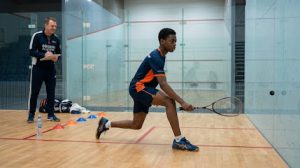
The summer period may have provided an opportunity to develop physical qualities, refine technique, and address weaknesses. As the new competitive season begins, however, young elite players need to convert that preparation into repeatable match performance.
High‑level performance for an experienced young squash player comes from developing the complete athlete — physically, technically, tactically and mentally. When all four pillars evolve together, a player’s game becomes sharper, more efficient, and far more competitive.
The objective, as the season begins, is therefore not simply to be fit.
It is to be match-ready.
From General Preparation to Squash-Specific Performance
Pre-season conditioning provides an important foundation, but elite Squash demands much more than cardiovascular fitness.
A competitive match requires players to repeatedly accelerate, decelerate, lunge, change direction and recover to the T. These actions are performed at high intensity, often with limited recovery time between rallies.
A player’s conditioning programme should therefore reflect the intermittent and highly dynamic nature of Squash.
This means developing:
- Acceleration and deceleration
- Change-of-direction ability
- Repeated high-intensity efforts
- Explosive movement
- Lower-body strength
- Core stability
- Aerobic capacity
- Recovery between intense efforts
The key question isn’t simply “How fit are you?”
It is:
“Can you maintain effective movement and decision-making when fatigue sets in?”
That is where physical preparation starts to become genuine Squash performance.
Movement Efficiency Is a Competitive Advantage

At the elite junior level, movement efficiency can have a significant influence on performance in a match.
Getting to the ball first is important. Getting there under control and in a position to play an effective shot is even more important.
Young players should develop the ability to:
- Read the opponent’s shot early.
- Accelerate efficiently.
- Establish balance at the point of contact.
- Execute the shot effectively.
- Recover quickly towards the T.
Poor movement can result in late contact, compromised technique, and unnecessary physical expenditure.
Efficient movement, by contrast, creates time – also in Squash, time is a valuable performance resource.
This is why movement quality should be treated as a fundamental component of elite junior development rather than simply another conditioning exercise.
Technical Consistency Under Pressure
There is a major difference between executing a technically sound shot during an isolated drill and executing that same shot when an opponent is applying pressure.
Elite players need repeatability.
Length, width, volleys, drops, boasts, crosscourts and attacking shots must remain reliable when the player is:
- Moving at speed
- Under time pressure
- Physically fatigued
- Dealing with an opponent
- Playing a tight score
- Recovering from a previous rally
Training should progressively bridge this gap.
Technical work should therefore evolve from controlled practice towards decision-making and match-specific scenarios.
The ultimate objective isn’t perfect technique in training.
It is an effective technique when it matters.
Tactical Intelligence Separates Good Players from Complete Players
Physical and technical development are only two parts of the performance equation.
At an elite level, players must also understand why they are playing a particular shot.
Shot selection should be influenced by factors such as:
- Opponent positioning
- Court position
- Ball quality
- Rally tempo
- Opponent weaknesses
- Scoreline
- Physical condition
A player who can recognise these variables as their own strengths can adapt their game accordingly has a significant advantage.
Young players should therefore be encouraged to become students of the game.
Analyse matches.
Identify patterns.
Understand why rallies are being won and lost.
Ask:
- What is my opponent trying to create?
- What am I allowing them to do?
- Where are my opportunities to apply pressure?
The better the questions, the better the tactical understanding.
Training Under Pressure
Competition creates psychological and physical demands that cannot always be replicated through traditional drills.
If players want to perform under pressure, elements of pressure should be incorporated into training.
This could include:
- Starting games at 8–8
- Practising closing out games
- Playing conditioned games
- Setting tactical constraints
- Creating consequences for specific errors
- Simulating tournament situations
- Playing against different styles and strategies
This isn’t about making every training session uncomfortable.
It is about developing adaptability and composure.
Elite players need to be able to execute when the score is tight, the legs are tired, and the opponent is applying pressure.
Training should prepare them for that environment.
Note, for ambitious young players, there can be a temptation to believe that additional training will always produce additional improvement – that isn’t necessarily the case.
Performance development depends upon the balance between training stimulus and recovery.
Young athletes also have demands outside Squash. School, education, travel, tournaments, and everyday life all contribute to the overall load.
Recovery should therefore be considered a fundamental part of the performance programme.
Key areas include:
- Quality sleep
- Appropriate nutrition
- Hydration
- Rest and recovery periods
- Mobility
- Training-load management
- Tournament scheduling
The objective is not to train as much as possible.
It is to create the conditions in which the athlete can adapt, improve, and perform consistently.
Measure Development Beyond Tournament Results

Winning matters – for an elite player, competition is ultimately about performing and achieving results.
However, tournament results alone do not provide the complete picture of development.
A player can lose a match while demonstrating significant improvement in movement, tactical discipline or shot quality.
Equally, a player can win while displaying weaknesses that need to be addressed.
Performance goals can therefore provide a more useful development framework.
Some examples include:
- Improving movement efficiency
- Increasing volley opportunities
- Reducing unforced errors
- Maintaining length under pressure
- Improving decision-making from the back corners
- Recovering consistently to the T
- Maintaining intensity throughout matches
These objectives give players and coaches measurable areas to develop.
The Elite Player’s September Checklist
As the competitive season begins, young players should assess their preparation across four key performance areas.
Physical
Can I maintain intensity and movement quality throughout a match?
Technical
Can I execute my key shots consistently when under pressure?
Tactical
Can I identify weaknesses and adapt my game during a match?
Mental
Can I remain disciplined and composed when momentum shifts?
And there is a fifth question that is often overlooked:
Recovery
Am I recovering sufficiently to train and compete at my best?
If one area isn’t where it needs to be, that isn’t necessarily a problem.
It is an opportunity for development.
Performance Is a Process, Not a Single Tournament
Elite Squash development doesn’t happen overnight.
There will be tournaments where everything comes together and others where the performance falls short of expectations. There will be breakthroughs, setbacks, injuries, difficult opponents, and periods where progress appears slow.
Note that the role of the player is to learn from each experience.
Train. Compete. Analyse. Adapt. Repeat.
That cycle is fundamental to long-term performance development.
It is about developing the physical capacity to sustain performance, the technical ability to execute under pressure, the tactical intelligence to make better decisions, and the mental resilience to compete effectively.
September is not simply the start of another Squash season.
It is an opportunity to take the next step in your development as an athlete.
Train with purpose. Compete with intent. Learn from every match.
Your next level starts with how you prepare for it.